letters in the digital age

2025-07-16 18:12:51 UTC Permalink

when was the last time you wrote a letter? like, a proper letter. for a lot of people, the closest thing could have been some thank-you cards as a child. if you were lucky, you were possibly taught how to format and write both casual and formal letters in English class. if you were very lucky, or if you were a nerd., maybe you had a pen-pal.

i've been trying my best to learn how to actually communicate effectively with people, as part of maintaining and growing meaningful relationships. there are so many facets to being in touch, and oddly, there isn't actually that much good advice on the topic. one would think asking older people would work, but simply being older is not ever indicative of a mastery of this aspect of life. well, i'm still figuring it out, but through experimentation i feel like i've accidentally discovered (along with those i practice with) an oddly forgotten methodology. letter writing.

everybody has different communication styles and strengths, and each kind of communication, the same. actively talking is one thing, but writing is another. sure, you can always write a long text. but the texting experience/medium is just utterly garbage for this. everybody hates long texts. the long text is less likely to have thought in it. it usually ends up being a long rant or a screed, absent of any editing, even at the level of a spell/grammar check. either it's a massive paragraph or it's a train-of-thought series of massive paragraphs, both hard to read and total slogs.

letters are different. traditionally, by nature of being a physical thing, they have gravity. upon reception, the sender has from-the-outset communicated a base level of intentionality. "i did not just write this, i had to sit down and make this for you.", inviting the reader to meet them where they are at and out of respect, at the minimum attempt to mirror any intentionality, patience, and thought in their reading.

all the benefits of long-form writing apply. it takes time. parts can be written on different days, communicating the nuances and developments that come from mulling over thoughts and feelings over extended periods. akin to journaling, there is the ability to converse with your past self. there is no rush. the act of care in editing takes time and leads to new epiphanies.

on a technical level, there is further expression in mixed media, attachments, styling (colors, calligraphy/font, decoration ?), layout. i think this idea alone has the capacity to be infectious. already i have mentioned it in passing to people and they have surprised me with letters, each in their own style. they are fully formed windows into personal thoughts and reflections in high definition. there are so many details to pick up on. the contrast with other formats is so stark. an acquaintance surprised me with a letter, and i felt able to subconsciously pick up the ridiculously high number of choices that must be made, were not made.

a one-to-one (or one-to-few), private dynamic distinguishes letters from public, published, long-form written media. prose is subtly different. however, finally dispatching the letter is somewhat reflective of publishing. the anxiety. it is no longer possible to make edits, add more information, details, etc. then one is left awaiting a possible reply, which will also take longer than usual, as the reader has to digest and possibly even write their own letter. any extended dialogue is slower. there is little risk of being accidentally brash. responses also don't have to be letters too. letters can spark multi-layered discussions and conversations. keep balances! don't get carried away and lost within the letters. use them as excuses to meet in person.

the letters also immediately become snapshots in time of feelings, thoughts, relationships, that can even be referenced and quoted in new letters, building an interconnected multi-dimensional canon of lives and relations, to be reflected upon in the far future.

--

the cool thing is basically all of this is accessible in combination with additional possiblities arising from a digital format. as such, i would like to introduce the retro-new concept of digital letter writing, utilising the building blocks of html and css.

html is the perfect format for letters as it encourages mixed media while being text-first. for those who do not know, html is hyper-text markup language, the language used in the web. it is usually used in combination with css (cascading style sheets), to render, format, layout and style webpages. html5/css3 are stable, being mature formats used over decades and likely to be here to stay much longer. they are also portable. every computing device with a web browser can open an html file.

in digital letter-writing, html is handwritten. all data is included in one file, everything embedded in the html. css styling is inline. images, videos, fonts, are all encoded as base64 urls. using html/css grants a similar level of expression you can achieve with a physical letter, with the benefits that come from a digital format, namely, said digital media. it is possible to embed interactivity that would not be possible with paper and pen: video, hyperlinks, sounds, games (?).

it is not a requirement to be restricted to html and css. if you know javascript or another programming language with web/wasm capabilities it's possible to build-in even more advanced interactivity. however, don't underestimate using only html and css. by sticking to a minimalist spirit it's easy to get carried away into css-demoscene-adjacent rabbit holes. css is capable of advanced animations, and interesting results can be reached with pseudo-classes and odd html element types1. such a mentality can also encourage a dig into the plain html, to discover a hidden layer of thought, as well as new methodologies to learn from one another.

learning html/css is easy if you've never done it. i will update this article with a video/text tutorial once i have finally finished that project, but for now, i would recommend the awesome mozilla mdn web docs. and these skills are also useful for building websites! if you don't enjoy directly writing everything from the start as html, i would recommend beginning with markdown (which is basically just fancy-formatted plain text), and then converting that to html using either a markdown-to-html web tool or something like comrak.

when you're done with your composition, all that's left to do is to optionally date it, either in-content or possibly as an html comment, then send the html file however you like. instant messenger, e-mail, physically mailed usb stick? then the recipient gets to download, view, and possibly archive it for safekeeping. i store my digital letters in a special folder in my documents folder, organised by dates, correspondents, threads. this manual aspect adds a differentiation to email, as well as the fact files must be managed locally and with respect and care to ensure data longevity.

as a proposition, i believe this concept could be taken further. this all is still somewhat of a starting point, and i think spreading the word a bit could help in unveiling new related ideas. so try it out and see where it takes you <3

p.s. on a separate note, i love the concept of paperless post. if i had more time i would develop some kind of paperless post clone, but even better, incorporating these ideas for further expression. paperless post tries to emulate paper but something more web-native could be cool.

p.p.s. this all has gotten me interested to read posthumously published letters too :)

Footnotes

  1. Inline CSS Puzzle Box: suricrasia.online ↩

streamingcore

2024-03-03 11:40:24 UTC Permalink

omg have you heard the new ariana grande album? it's so good. it's called sweetener. you have to listen to it.

β€” cel, probably like 2017 or something

so there's a new ariana grande single and it's her first in over 3 years i think? i've listened to it a couple times now and it just sounds like ariana grande which is like idk whatever. but girly pop when i went to check it out on my music player i saw THIS
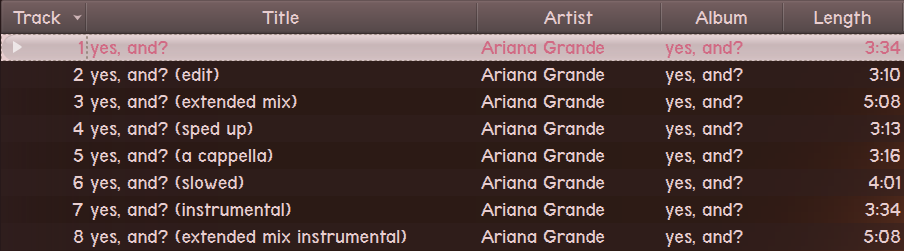
qobuz screenshot

i'm now thinking of all the permutations that must be capitalised upon to get all the revenue from the youtube edits. where is my yes, and? (a cappella sped up) and my yes, and? (slowed extended mix instrumental edit)? hello????

just reminded me of how sad the state of music culture (for most people) 'nowadays' is. i actually don't know if it was much better in the past since i was literally not alive and also engaging with that until the last decade or so i guess lol. it would be cool to hear if there's more to this idea of enshittification than rose tinted nostalgia. i'm pretty sure it's a thing but hey.

everything is driven by the recommendation algorithms people use on their cheap-ass streaming services, and as a result the kind of music that is being made is very much catered to survive in this scene. the fact that the main source of marketing for music is tiktok makes this issue even worse. probably the most exacerbated example of this would be kpop, in which songs can quite literally be released as little more than an undeveloped hook, and regular mini-albums at short lengths are all the rage. exhibit a: literally anything by NewJeans.

get up by NewJeans

there's also another thing i've been thinking on lately, which is i feel that recommendation algorithms inherently destroy culture due to lack of human decision or will. people used to go by culture journalism (F for pitchfork) or word of mouth, as well as literally sharing physical media or files. there would be more intention put into what we listen to. the fact that youtube-recommended-core exists is somewhat indicative of this, and shows the dangers of homogenisation that algorithms can bring. btw i don't want to say algorithms are wholly bad, mainly that they are horrible as a primary source.

where has the hunt for a good album gone? there is no risk/reward factor any more. it's too easy to never listen to a wide variety of music as you will perpetually be fed songs that are similar to that which you already like. without algorithms you have to sit aside and think about your music habits. you have no choice other than to manually look through new releases where u will inevitably be confronted with genres and artists u have never considered before. or you actually have a good reason to seriously think on that album your friend recommended or lent to you. if you can even get ahold of it anyway due to the differences in platform/drm.

which brings me to the next difference in consumption pattern, streaming versus owning. streaming from a seemingly unlimited library is a completely different dynamic to owning albums. when buying and/or downloading music we are forced to appreciate what we have rather than the unlimited depths of that streaming platform. we usually engage with full releases rather than just bits. it's easier to form connections even with garbage simply because we were stuck with it. it's what we had at the time. obtaining music in this way is slower and forces us to properly process that we once chose instead of immediately moving on to the next thing dropped in front of us.

this also doesn't even begin to cover the fact that the rise of streaming services has in fact been bad for artists (unless you are with a big label that has their own agreement with the service) and that it's all inevitably going to tumble since it's wholly unsustainable and unprofitable.

where do we go from here? honestly, the only solution i have felt contends is piracy. transfer files to your friends, get on soulseek, torrent, torrent, torrent. if u can afford it, buy albums you love direct from the artist. once album a month is already more money to artists than u give through paying for a streaming service and really only contributing to upholding this garbage system. of course there are also even more arguments for piracy, most notably the fact that it remains essentially the only reliable way to archive media and allow it all to stand the test of time, in addition, it's totally just a better user experience than dealing with whatever the fuck drm is. piracy democratises music listening too. people in places where an album isn't available or sold or too expensive can access it and enjoy it, which is the best tbh.

i guess i'm going to try writing about music i love (and hate) on this blog a bit when i feel like it now. i don't really know how to write about this stuff well but i'll never get good if i don't try. also this is now the second mention of ariana grande on this blog. on my second post. i guess this is an ariana grande hate blog now. i will make sure the next post is positive in some way before the vibes of this place get rancid.

p.s. (sadly) nobody will ever make an equivalent to the coolness that is taping a shitty quality cassette mixtape for your friend. i wonder if techbros would put playlists on the blockchain and make playlist nfts oh wait they wont because blockchains are total rot and would never have that kind of usability however dumb of an idea it is

rot

2022-04-27 08:48:30 UTC Permalink

i want to write something about rot. why not? i think it's become my favourite word over the last few months. it's so versatile.

what is rot? it is pure decay. it is horrid yet undeniable. there is no way to tell at a glance at what point it became rot, and whatever it used to be, was surely destined for this end. perhaps it was always rotted to begin with. there is no way of knowing, only that now, at this time, it is surely rot.

rot in my opinion represents a state of post-cringe, a state of absurdism. how is rot post-cringe? it is something so bad that when you experience it it no longer triggers your cringe response, you simply accept it for what it is. this is most definitely absurd. there is no more meaning to it but rot. there is no interpretation, there is no saving it from this state, it is past the point of no return.

how can we solve rot? in my opinion there is only one solution: abandonment of that which is rotted. rot is not worth saving. however we can start anew, and from the rot allow that which is new to grow, even if it shall most likely reach the same end.

the worst kind of rot is that which pretends to not be completely rot, which is propped up by some as being salvageable, or in some cases, perfectly acceptable and maybe even a net positive. some examples of this include:

  • beaurocracy
  • power structures
  • money
  • ariana grande
  • neoliberalism

it is undeniable these are rotted to the core.

i hope this aids in you understanding this term. maybe now you see rot in a different light, and that it could help you in making sense of the world.

β€” cel